Industrial drying and psychrometrics: dryer design on the h-x diagram
Psychrometrics in industrial drying: the drying phases, energy balance, recirculation and a wood-dryer example. Calculations on the h-x diagram.
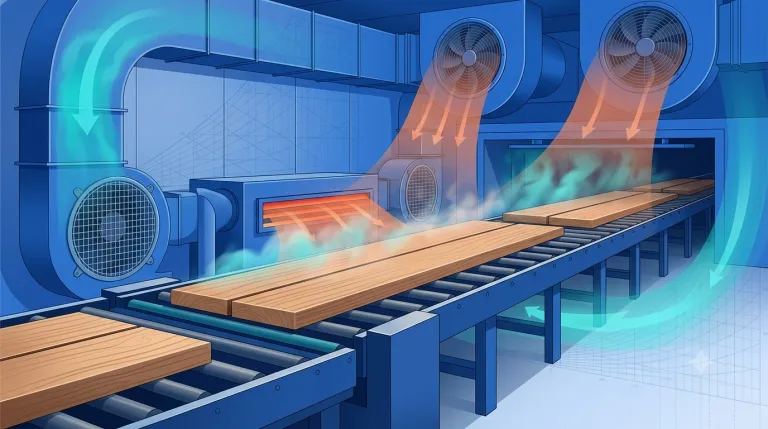
Industrial air drying is a psychrometric process: hot dry air comes into contact with wet material, takes up the evaporated water and leaves the dryer as more humid air. Setting the temperature, humidity and flow rate of the drying air correctly means minimizing energy use, maximizing the drying rate and not damaging the material — and the h-x diagram is built for exactly these calculations.
The two phases of drying and their psychrometric profile
The constant-rate drying phase
There is enough free water on the surface of the material. Drying proceeds as evaporation from a free water surface — the rate is constant and depends only on the air conditions (temperature, humidity, flow velocity). The air takes up moisture at an approximately constant wet-bulb temperature, that is approximately along an isenthalp. All the energy goes into evaporation and the material temperature stays low (close to the wet-bulb temperature).
The falling-rate drying phase
The free water has been removed from the surface, and the remaining moisture migrates from the interior of the material to the surface by diffusion. The drying rate falls and the material temperature rises (approaching the dry-bulb temperature). This phase is critical for quality — drying too fast causes cracks in wood or a hard crust on food. It is controlled by lowering the temperature or raising the humidity of the drying air.
The psychrometric parameters of the drying air
- Supply-air temperature — the higher it is, the faster the drying, but it is limited by the sensitivity of the product. Wood 50–90 °C depending on the species and the kiln schedule, food 40–70 °C, paper 100–150 °C.
- Relative humidity of the exhaust air — determines the utilization of the drying air. A higher means less air is needed, but slower drying.
- Air flow rate — a larger flow = faster drying, but higher operating costs.
Calculating the evaporated water and the energy balance
The amount of evaporated water:
(if is substituted in g/kg, the result must be divided by 1000 so that comes out in the same units as )
The heater capacity, which only preheats the air at a constant humidity ratio:
This, however, is not the total energy demand of the dryer. The heater merely conditions the air — the latent heat of the water the air carries away comes on top of it in the balance. The total heat input follows from the exhaust state and from the flow of fresh air , that is the air which actually passes through the dryer and leaves, not the recirculated loop:
The specific energy use per kilogram of evaporated water is [kJ/kg]. Conventional dryers without heat recovery typically land at 3,000–6,000 kJ/kg. The physical floor is the latent heat of water, roughly 2,400 kJ/kg — if you come out below that, something is missing from the balance.
Recirculation: what it actually saves and what it does not
A large part of the operating savings comes from recirculating the exhaust air, which is warmer than the outdoor air — venting it out and replacing it with cold fresh air would be wasteful. Recirculation returns part of the exhaust air to the inlet, where it mixes with fresh air and is reheated. On the h-x diagram this is a mixing point on the line joining the exhaust and the outdoor state; where the point sits on that line corresponds to the recirculation fraction .
How much this saves is a common source of error. If only the fraction of the air is vented, the heat input falls exactly in proportion to — but so does the amount of water evaporated, because the supply air is already pre-humidified and can take up less further moisture. The batch takes proportionally longer. Substitute the mixing into the balance and the cancels out:
The specific energy per kilogram of evaporated water is therefore completely independent of the recirculation fraction — it is governed only by the exhaust and outdoor states. Recirculation reduces the heater capacity, and with it the size of the heat source, but on its own it saves no energy in drying the batch.
The same formula shows where the savings do lie: in a more humid exhaust. Every kilogram of air leaving the building should carry out as much water and as little heat as possible. And that is exactly what recirculation is for — it is what keeps the humidity in the chamber high without bringing the drying to a halt.
The limit is the buildup of moisture — the higher the humidity ratio of the supply air, the weaker the driving force of drying and the longer the batch takes.
Example: a wood dryer from 60% to 12% moisture (dry basis)
Wood moisture is given in practice on a dry basis (referenced to the dry mass, not the total wet mass). For a charge with a dry mass of 6,250 kg (i.e. 10,000 kg of wet wood at an initial moisture of 60% dry basis), the initial water content is kg, and the target at 12% is kg — so 3,000 kg of water has to be evaporated.
The drying air circulates through the chamber at 10 kg/s (of dry air): supply 60 °C / φ = 15% (, ), exhaust 60 °C / φ = 45% (, ), so . The outdoor air is 20 °C / φ = 60% (, ).
Note that the supply air has a higher humidity ratio than the outdoor air. Heating the outdoor air alone would never produce it — heating runs at constant and would give 60 °C / φ = 7%. The supply state is a mixing point: roughly 20% recirculated exhaust and 80% fresh air, and only then heated. So 10 kg/s circulates through the chamber, but only ≈ 8 kg/s leaves it and is replaced by fresh air.
Drying time:
This is the theoretical (shortest possible) time, assuming the exhaust air leaves at exactly φ = 45% throughout. In reality, drying takes longer — once the falling-rate phase sets in (see above), the exhaust air is no longer as humid and the driving force of the process decreases.
The heat input is calculated from the fresh air flow and the exhaust state — that is the only way the latent heat of the water carried away enters the balance:
The specific energy is of evaporated water — inside the usual range and safely above the latent heat of water. Had we counted only the heating of the supply air, , we would have arrived at 1,620 kJ/kg, less than the evaporation alone costs — and that is impossible.
More recirculation shrinks the heat source but lengthens the batch in proportion:
| Recirculation | Supply air | Heat input | Time | Specific energy |
|---|---|---|---|---|
| 0% | 8.8 g/kg (φ 7%) | 1,770 kW | 1.6 h | 3,400 kJ/kg |
| 20% | 19 g/kg (φ 15%) | 1,420 kW | 2.0 h | 3,400 kJ/kg |
| 40% | 30 g/kg (φ 23%) | 1,060 kW | 2.7 h | 3,400 kJ/kg |
| 60% | 40 g/kg (φ 31%) | 710 kW | 4.0 h | 3,400 kJ/kg |
| 70% | 45 g/kg (φ 34%) | 530 kW | 5.3 h | 3,400 kJ/kg |
The relative-humidity column shows why recirculation is indispensable: supply air at φ = 7% would dry the lumber fastest, but the surface would crack. (Verify the specific values for your conditions on the PsychroView h-x diagram.)
Applications across industries
- Wood processing — chamber kilns at 50–90 °C; the quality of the dried lumber is assessed per EN 14298 (European standard).
- Food industry — low temperatures (40–60 °C) to preserve nutritional value, with precise humidity control.
- Paper industry — very high temperatures (100–150 °C), continuous operation, the main energy consumer of the production.
- Ceramics and building materials — slow drying without thermal shocks, to avoid cracking.
Frequently asked questions
Why does the material temperature not rise in the first phase of drying? Because all the supplied energy goes into evaporating the free water. The temperature of the wet surface in the flowing air settles at approximately the wet-bulb temperature of the drying air — only after the free water is removed does the material start to heat up.
How much can recirculation save? The heater capacity falls in proportion to the vented fraction — with 60% recirculation, to roughly 40%. On its own, though, that saves no energy in drying the batch: the drying takes proportionally longer and the consumption per kilogram of evaporated water stays the same. That figure is set by the exhaust state alone.
Do drying wood and grain differ? The principles are the same; the temperature ranges and the product’s sensitivity differ. Drying crops is covered in the article Psychrometrics in agriculture.
Try PsychroView for free
Interactive Mollier diagram directly in the browser. No registration required.
Open app →Or browse example projects to see real HVAC calculations.
Keywords: industrial drying, drying psychrometrics, dryer design, air recirculation drying, h-x diagram