Cleanroom air: psychrometric temperature and humidity requirements
Psychrometric requirements for cleanrooms per ISO 14644 and EU GMP: the effect of humidity on ESD and microbial contamination, and HVAC design.
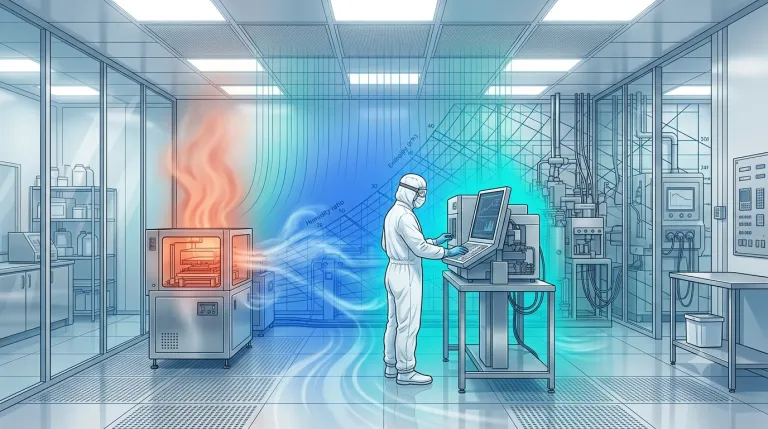
In a cleanroom, humidity and temperature are not just a matter of thermal comfort — they are critical process parameters whose deviation can cause the degradation of a drug, the failure of an electronic component or the contamination of a sterile product. Psychrometrics is a fundamental issue to address here, and the h-x diagram is the tool that verifies the air-treatment design.
Cleanroom classification and its effect on air conditioning
ISO 14644-1:2015 classifies cleanrooms by the number of particles per m³ — from ISO 1 (the cleanest) to ISO 9 (e.g. an office). Higher cleanliness demands a higher number of air changes, and thus higher demands on temperature and humidity control:
| Class | Application | Air changes | Tolerance |
|---|---|---|---|
| ISO 5–6 | Pharmaceutical manufacturing, microelectronics | 240–600 /h | ±0.5 °C, ±2–5% RH |
| ISO 7–8 | Packaging of sterile products, operating theaters | 60–240 /h | ±1 °C, ±5% RH |
Every air change means an enthalpy input that the air conditioning has to compensate for. At hundreds of changes per hour it becomes the dominant load, far exceeding the load from people or equipment.
The effect of humidity on the product and the process
Electrostatic discharge (ESD)
Below 30% RH, the ability of surfaces and clothing to generate an electrostatic charge increases. A discharge (ESD) can damage or destroy a semiconductor component. Chip fabs and SMT assembly lines therefore keep RH at 40–60% or install antistatic floors and ESD-protective elements.
Microbial contamination
Bacteria and fungi need water to grow. Above 60–65% relative humidity, the risk of contamination of surfaces, filters and the air handling system rises. In the manufacture of sterile products, a maximum RH of 50% is a standard requirement; EU GMP Annex 1 (2022) lists RH as a monitored critical environmental parameter.
Crystallization and substance stability
Hygroscopic active pharmaceutical ingredients absorb moisture and change their properties — dissolution rate, stability, polymorphic form. Tablet manufacturing typically requires RH 40–50% at 20–22 °C, where a deviation of 5% RH can affect the compressibility of the granulate.
Psychrometric analysis on the h-x diagram
The air conditioning design of a cleanroom must simultaneously ensure:
- a) the precise indoor condition (a point on the diagram with a small tolerance region),
- b) a sufficient flow of cold air to remove the thermal load,
- c) the correct humidity of the supply air without condensation in the ductwork.
The procedure: mark the required indoor state with its tolerances (a small region around the point), plot the outdoor air for both a summer and a winter day, and draw the treatment path — mixing, cooling, dehumidification, heating, humidification — so that the supply-air state compensates for the load and keeps the room within the required tolerance.
Example: tablet manufacturing, summer
Indoor conditions 22 °C / 45% RH (±2 °C / ±3% RH), summer outdoor air 32 °C / 55% RH, class ISO 7, 120 air changes/h. At (a predominantly sensible load) the supply air will be about 16 °C / 45% RH — corresponding to a humidity ratio . The outdoor air is mixed with recirculated air (22 °C / 45%), the resulting mixture of 28 °C / 52% RH is cooled and dehumidified to about 5 °C / 95% RH (to the required ) and then reheated to 16 °C / 45% RH (the reheating runs at constant x, so the temperature rises and φ falls from 95% to 45%). (Exact calculations per ISO 14644 and EU GMP require system validation; the values are illustrative.)
Control: precision is a condition of qualification
A cleanroom air conditioning system must be qualified and validated per EU GMP Annex 15 and ISPE Guidelines — with verification that it maintains temperature and humidity within tolerance under all operating states (a summer and a winter day, full load, a branch outage). The control loops for humidity are typically cascaded: a master loop watches the room humidity, a slave loop controls the humidifier or coil output. For a precision of ±2% RH, a calibrated capacitive sensor (at least ±1% RH) is required.
Frequently asked questions
Why does low humidity matter in electronics manufacturing? Below 30% RH the air behaves as an insulator and surfaces readily generate an electrostatic charge. A discharge through a sensitive component damages it — which is why RH is kept at 40–60%.
What is the maximum humidity for sterile pharmaceutical manufacturing? Usually 50% RH, because higher humidity encourages microbial growth. EU GMP Annex 1 ranks RH among the monitored critical parameters.
Why is the air load of a cleanroom so high? Because of the tens to hundreds of air changes per hour. Each change brings an enthalpy input that the air conditioning must compensate for — which is why the load from the air exceeds that from people and equipment.
Try PsychroView for free
Interactive Mollier diagram directly in the browser. No registration required.
Open app →Or browse example projects to see real HVAC calculations.
Keywords: cleanroom, cleanroom humidity, ISO 14644, GMP HVAC, cleanroom temperature humidity