Condensation in buildings: causes, calculation and prevention
When and where water vapor condensation occurs, surface vs. interstitial condensation, and how to predict it from the dew point and h-x diagram.
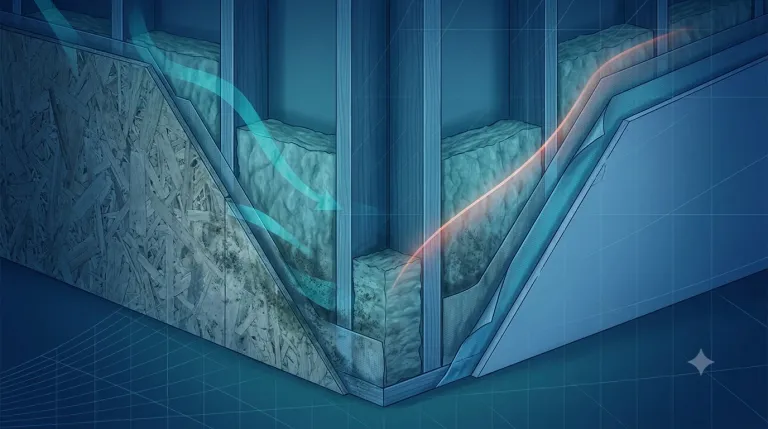
Water vapor condensation never happens by chance. It happens whenever the surface temperature drops below the dew point of the surrounding air. This condition is unambiguous, predictable and — if you know it in advance — you can take preventive measures. That is exactly why psychrometrics has a direct economic impact in building physics: a badly designed vapor barrier or missing insulation causes defects whose repair costs many times more than a correct design.
The physics of condensation: from vapor to droplet
Water vapor is an invisible component of air under normal conditions. Condensation occurs as soon as the air is supersaturated — the amount of vapor exceeds the saturation value for a given temperature. This happens either by adding more vapor (a shower, cooking, breathing) or by cooling the air below its dew point. The rate of condensation depends on the difference between the partial vapor pressure in the air and the saturation pressure over the surface — the colder the surface, the faster the condensate builds up.
Surface condensation is visible and immediate
It forms on the inner surface of a structure when its temperature drops below the dew point of the indoor air. Typical examples: a fogged-up window in winter, droplets on a cold pipe, a damp corner behind furniture in an unheated spot.
The condition for it: . The dew point for ordinary winter conditions (20 °C / 50% RH) is about 9.3 °C — any surface colder than 9.3 °C (a thermal bridge, an unheated corner, a poorly insulated window) will be wet in winter.
How to assess the risk
On the h-x diagram we find the indoor-air state, draw a vertical line from it (constant x) down to the saturation curve — the intersection gives the dew point . We compare it with the lowest surface temperature in the room. The temperature factor at the internal surface per ISO 13788 expresses how close the surface is to the dew-point temperature, and it must satisfy .
Interstitial condensation is hidden and more dangerous
The more insidious form occurs inside the structure, for example within an insulation layer, in a cavity wall, under a roof covering. Water vapor penetrates by diffusion from the warm side (interior) to the cold side (exterior), and where the temperature drops below the dew point of the vapor at its given partial pressure, it condenses. It is invisible until it shows up as mold, wood rot or a structural defect. The repair is then many times more costly.
The Glaser method vs. dynamic simulation
The classic Glaser method (embodied in ISO 13788) works with steady-state conditions: for each month it computes the distribution of temperature and partial vapor pressure across the section and identifies the layers where vapor condenses. Simple, conservative, standardized. Dynamic simulation (WUFI, EnergyPlus) tracks the heat and moisture flow throughout the year, including the structure’s ability to dry out — it is more accurate but more demanding on inputs.
A practical example
An external wall: 300 mm masonry + 160 mm mineral wool + facade render. Conditions: interior 20 °C / 55% RH, exterior −12 °C / 80% RH. The temperature at the masonry/wool interface is about −2 °C, the dew point of the vapor diffusing through the masonry about −5 °C. Because −2 °C > −5 °C, condensation at the interface does not occur. If we reduced the insulation thickness to 80 mm, the interface temperature would fall to −8 °C and condensation would occur. (Verify the exact temperature profile in building-physics software; the values are indicative.)
Ventilation as a moisture-control tool
Ventilation is the most effective way to reduce indoor humidity and push the dew point down. An air change rate of 0.5 h⁻¹ per hygiene standards removes most of the moisture produced by occupants. In rooms with high moisture production (bathroom, kitchen, pool) natural ventilation is not enough and mechanical ventilation with sufficient capacity is required (in a bathroom, local extraction of 50–90 m³/h). In practice it is important to keep the air state far enough from the saturation curve, which can be tracked visually in PsychroView.
Recommendations by type of space
- Windows — double glazing () keeps the inner pane at about 15–16 °C when it is −12 °C outside (and 20 °C inside); triple glazing () raises the glass temperature above 17–18 °C and gives a larger margin. The actual value depends on the indoor conditions and the chosen surface resistance layer (Rsi).
- Basements, cellars, garages — insulation from the ground and controlled ventilation are essential; warm humid air brought into a cold basement in summer condenses immediately.
- Bathrooms — a vapor barrier on the ceiling, direct air extraction from the shower enclosure, tile surfaces above the dew point.
Frequently asked questions
What is the unambiguous condition for condensation to occur? A surface temperature lower than the dew point of the surrounding air. You read the dew point off the h-x diagram or a calculator and compare it with the coldest point of the structure.
Why is interstitial condensation more dangerous than surface condensation? It is hidden inside the structure and only shows up as biological or structural damage, often after years. It requires a calculation per ISO 13788 or a dynamic simulation.
Does reducing humidity help against condensation on windows? Yes. Lower indoor humidity lowers the dew point, so even colder glass stays dry. An alternative is to raise the glass surface temperature with better glazing (triple glazing).
Try PsychroView for free
Interactive Mollier diagram directly in the browser. No registration required.
Open app →Or browse example projects to see real HVAC calculations.
Keywords: condensation in buildings, water vapor condensation, interstitial condensation, building physics, vapor barrier